Fiction Made Flesh
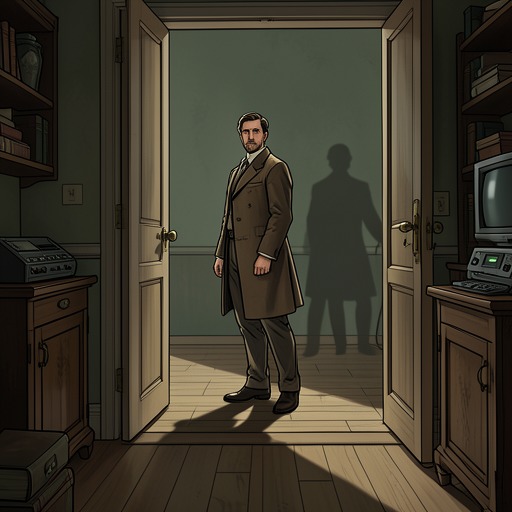
The Dark HalfFiction Made Flesh names the passage by which George Stark ceases to be only a character invented by Thad Beaumont and exists as an independent force in the world. Its significance lies not in a simple author-to-character act of creation, but in the story’s increasingly unstable account of who made Stark: Thad, an unacknowledged part of himself, a shared history between the two, or Stark himself. As the explanations accumulate, the distinction between fiction and reality becomes a problem of identity and responsibility rather than a boundary anyone can confidently police.
From authorship to responsibility
Thad’s thoughts about Stark’s return turn the question of creation inward. He considers whether he truly created Stark, then confronts the possibility that some longing part of him allowed Stark to be recreated. He is frightened that a part of himself may be holding back an answer about how to use the sparrows because it does not want Stark to die. The prospect is not merely that an invented figure has escaped his author; Thad may remain emotionally implicated in the figure’s survival. His conviction that Stark is a bastard coexists with the disturbing suggestion that some part of him finds Stark attractive.
The uncertainty deepens when Thad asks who brought Stark back to life and receives the answer, “The owner. The knower.” The words identify no external agent and do not settle whether Thad consciously acted. Instead, they connect possession and knowledge to an act whose source remains obscure even to him. His immediate cry that he did not mean to do it makes intention central: the story distinguishes bringing Stark into being from understanding, choosing, or wanting that outcome.
Alan’s revised explanation
Alan Pangborn reaches a new interpretation through the physical traces associated with Stark. He wonders why Fuzzy Martin would not have recognized the black Toronado if it had been stored in his barn all along, and entertains the possibility that elements of Stark’s life come into being where Thad needs them, but not necessarily where he needs them to appear. In this account, Stark’s car turns up where Thad stored his own, just as Stark’s emergence is linked to the graveyard where Thad symbolically buried him. Objects and places connected to Thad’s life seem to offer a pattern for how a fictional life can acquire material consequences.
The theory unsettles Alan’s habits of thought, but it also makes him reconsider Thad’s earlier statement that he does not know who he is when he is writing. Alan arrives at the possibility that Thad and Stark are not simply author and product: “You were him, weren’t you?” he says, understanding the killer as having grown through their shared identity. The revelation changes the apparent direction of causality. Rather than a self-contained character merely breaking free from an author, Stark’s growth may express an identity already entangled with Thad’s.
A shared history before embodiment
During the hostage crisis at the Beaumont lake house, Stark offers Alan his own account. He says he wants a kind of transfusion because something in him has temporarily stopped working, and believes Thad can restore it; Stark describes his own capacities as having been built from Thad’s. His explanation presents their connection as bodily and reciprocal, not solely literary. Alan silently rejects Stark’s implication that Thad alone supplied the source, reasoning instead that the two had been connected all along.
Alan’s thoughts supply the history Stark does not appear to know: Thad tried to end the connection before he was born, and Dr. Pritchard later intervened when Thad was eleven. That intervention worked only for a time. Thad eventually invited Stark back without understanding what he was doing, because Pritchard had never told him about the surviving connection. Alan consequently understands Stark as the ghost of Thad’s dead brother, while also recognizing that the two are more—and less—than that description. The account ties Stark’s emergence to Thad’s concealed twin history without reducing their present relationship to a straightforward supernatural return.
The word made flesh—and self-made
Stark connects his arrival to the twins who would have been William and Wendy Beaumont’s older siblings. He describes his emergence after their deaths as a kind of balancing act, then concedes that the explanation sounds absurd even to him. His formulation, “The word became flesh,” gives the story’s central transformation a deliberately self-conscious shape: language appears to cross into embodied life, yet Stark insists that the circumstances matter less than the fact that he is present. Alan disagrees, believing that how Stark came to exist may be precisely what can save them.
Stark’s account finally destabilizes the idea that Thad was the sole creator. He says that, after events reached a certain point, he created himself, and links his difficulty writing to the energy consumed by making his own existence. His claim does not erase Thad’s role: Stark still describes his equipment as derived from Thad, while Alan sees their history as shared and Thad fears his own unacknowledged desire may have enabled Stark’s return. Instead, the different accounts make creation recursive. The writer supplies the conditions for the character; the character becomes an agent in his own making; and the resulting figure cannot be understood apart from the hidden history that preceded either explanation.
Narrative and thematic significance
The concept makes the novel’s metafictional premise consequential within its events. Writing is not simply representation: Stark’s existence forces the characters to ask whether words can produce a life, whether a created identity can develop an agency of its own, and whether an author remains responsible for what he has made. Yet the story resists a clean rule. Thad’s involuntary involvement, Alan’s interpretation of the twins’ history, and Stark’s assertion of self-creation remain overlapping explanations rather than a single settled mechanism.
That unresolved overlap gives Fiction Made Flesh its force. The supposed divide between the real author and the fictional character is crossed, but neither side remains intact: Thad’s identity is implicated in Stark, while Stark claims an origin that exceeds deliberate authorship. Embodiment is therefore both a supernatural event and a crisis of interpretation. To discover how the fiction became real is not an abstract puzzle for Alan; he believes that understanding the origin may be the means of stopping Stark.